

Prenatal Testing
Prenatal diagnosis is considered an essential part of modern obstetric care, allowing doctors to identify genetic and chromosomal conditions in fetuses before birth. With the advancement of neonatal care, the knowledge about any conditions the fetus carries enables the obstetric and neonatal team to prepare a targeted plan for the care and pre-organise the expertise required for the neonate at birth and in the immediate postnatal period.
Testing Options
Centre for Women’s Ultrasound offers a comprehensive range of prenatal testing options for your pregnancy. This includes non-invasive prenatal testing (NIPT), carrier screening, Vistara testing for single-gene disorders, amniocentesis and chorionic villous sampling. Each test provides specific insights into genetic or chromosomal conditions, enabling expectant parents to access clear and reliable information about their baby’s development and health.
Non-Invasive Prenatal Testing (NIPT)
NIPT is a genetic test for Trisomy 21 (Down Syndrome), Trisomy 13 and Trisomy 18, as well as testing of the gender chromosomes, using fetal DNA in maternal blood. During your pregnancy, your blood contains DNA from both you and your baby’s placenta. Non-invasive prenatal testing (NIPT) is a blood test performed during pregnancy that looks at the placental DNA to see if there are signs of certain chromosomal conditions, such as Down syndrome, that could affect your baby’s health. NIPT can also identify your baby’s sex.
NIPT tests are a safe, non-invasive way to screen your baby for chromosomal conditions as early as nine weeks into your pregnancy. NIPT provides the highest accuracy, over 99% compared to maternal serum screening (70%) and the nuchal translucency program (90%) for chromosome trisomies.
Panorama NIPT at Centre for Women’s Ultrasound
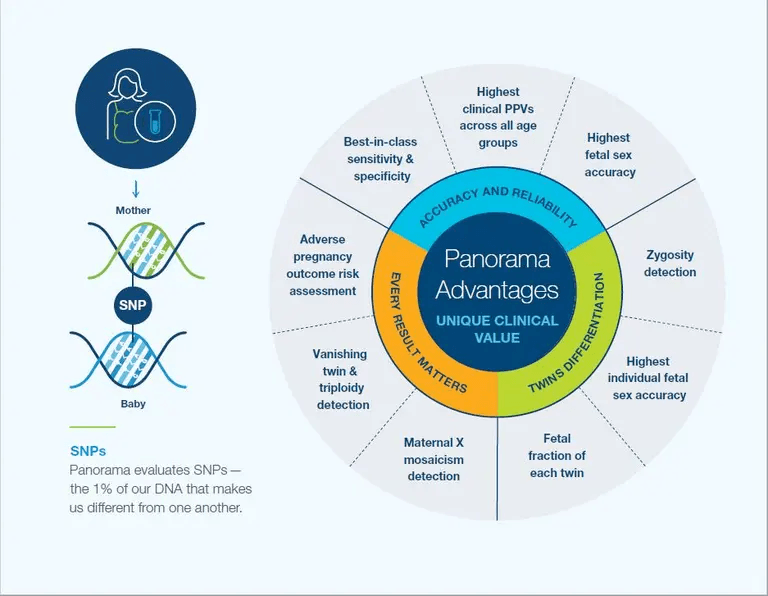
Centre for Women’s Ultrasound offers Natera Panorama NIPT as an authorised distributor. Panorama’s single-nucleotide polymorphism (SNP)—based non-invasive prenatal test (NIPT) differentiates fetal (placental) DNA from maternal DNA as early as 9 weeks of gestation, with distinct clinical advantages over conventional NIPTs.
Panorama is the only NIPT test that can identify conditions such as vanishing twin, triploidy and maternal X mosaicism, all of which can lead to inaccurate results with other NIPT tests.
Panorama non-invasive prenatal testing offers exceptional screening performance for chromosome microdeletions, including 22q11.2 deletion syndrome, a common and potentially severe microdeletion that impacts pregnancies equally regardless of maternal age.
Panorama also offers an extended NIPT that includes 5 microdeletions
Only Panorama reports zygosity (identical and non-identical twin status), individual fetal fractions for dizygotic twins and fetal sex for each twin.
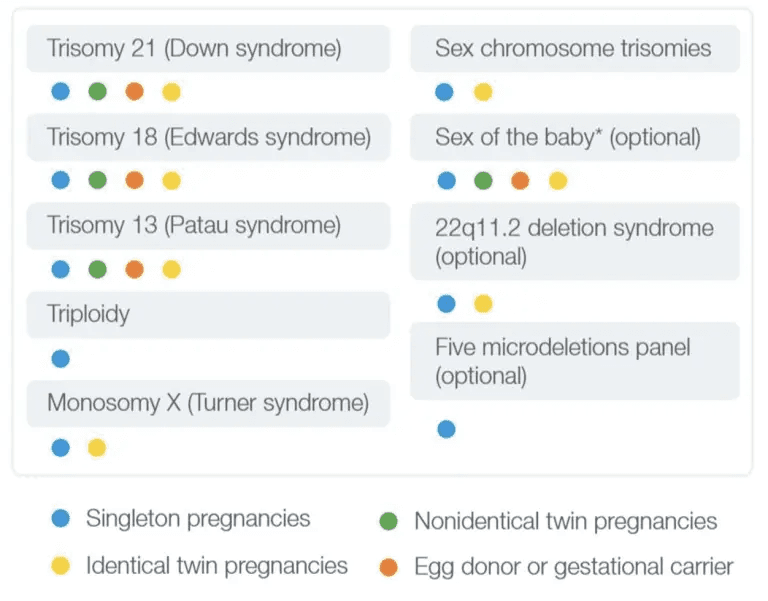
The following is a summary of the testing results available through Panorama.
A low-risk result means that the chance your baby has one of the conditions tested by Panorama is very unlikely, but not zero, less than 1 in 10,000 for most conditions.
A high-risk result means that your pregnancy has a higher chance of having a specific genetic condition. However, you cannot know for sure if your baby has that condition based on the screening result alone. Diagnostic testing, such as amniocentesis or chorionic villous sampling, is recommended for a high-risk NIPT test result.
NIPT can be performed for twin pregnancies, although the reliability is less than for singleton pregnancies. Panorama NIPT is the only NIPT offering separate gender identification for identical or non-identical twin pregnancies.
VCGS Percept NIPT at Centre for Women’s Ultrasound
Percept NIPT is a non-invasive prenatal screening test offered by VCGS that assesses the likelihood of a chromosome condition, such as Down syndrome, in your pregnancy by analysing your blood sample after 10 weeks’ gestation. It delivers either a “high-chance” or “low-chance” result, and if a high-chance outcome is returned, genetic counselling is provided to help clarify next-steps. However, it’s important to note that the test does not detect every possible genetic or chromosomal condition.
There is a small failure rate of the NIPT test, depending on the amount of fetal DNA that can be detected in the mother’s blood sample. It is also important to note that approximately 25% of chromosome abnormalities in pregnancy, as well as major structural anomalies, are not detected by an NIPT test. A 12-14 week first-trimester fetal morphology scan is recommended as part of your first-trimester screening with NIPT.
The following brochures and QR code have further information regarding our NIPT test options and prices offered by the Centre for Women’s Ultrasound.
First trimester screening options
Panorama & Horizon – CFWU Pricing 2026
Panorama Microdeletion 22q11.2
Percept NIPT brochure- percept NIPT for Health Professionals – VCGS

Carrier Screening
Carrier screen is a DNA screening test that provides information on your chance of having a child with an autosomal recessive or X-linked genetic condition. Carrier status for genetic conditions is common, and family history is often not a good predictor. Most people are carriers of at least four to six genetic conditions. Most carriers are healthy because the other copy of the gene works normally. Carrier couples are at an increased risk of having a child with a genetic condition.
VCGS Prepair carrier screening-link to website –prepair Carrier Screening for Patients – VCGS
Prepair 3
Prepair 500
Prepair 1000
Horizon Carrier Screening
Horizon Carrier Screen tests through the Centre for Women’s Ultrasound screens for up to 274 autosomal recessive genetic conditions and X-linked genetic conditions. All Horizon Panels include four essential conditions: Cystic Fibrosis (CF), Spinal Muscular Atrophy (SMA), Fragile X syndrome and Duchenne Muscular Dystrophy (DMD).
Carrier screening can be performed at any time before or during pregnancy. Some people may want to know their carrier status before pregnancy to inform reproductive decisions.
The following brochure gives further information on carrier screening available at the Centre for Women’s Ultrasound:

Vistara -NIPT for single gene disorders
- Vistara looks for small DNA changes, or single gene mutations in cell-free fetal (placental) DNA that may have otherwise gone undetected prenatally
- Conditions screened for by Vistara are not screened by standard NIPTs
- Vistara screens for serious conditions across 30 genes, which are commonly caused by de novo mutations and usually not inherited or tied to patient or family history. Conditions include Noonan syndrome, osteogenesis imperfecta and Rett syndrome
- Prenatal testing for these conditions can lead to improved delivery management, targeted neonatal care and more comprehensive prenatal education for parents
Amniocentesis
Amniocentesis is a medical procedure performed under ultrasound guidance during pregnancy to extract amniotic fluid from around the fetus. The fluid contains fetal cells and various chemicals that provide genetic and other information regarding the health and well-being of the fetus, including chromosomal and genetic anomalies and infections in the pregnancy.
The procedure is performed by doctors highly trained in fetal procedures after 15 weeks of pregnancy and is generally considered safe, although there is a small procedure-related risk considered to be approximately 1:600 cases when performed by experienced operators.
Our doctors at CFWU are among the most experienced in performing amniocentesis and CVS procedures when required for testing in pregnancy. We are happy to provide consultation to discuss the benefits and risks associated with the procedure prior to making decisions regarding testing options.
Chorionic villous sampling
Chorionic Villous Sampling (CVS) is a prenatal diagnostic test that involves the removal of a small sample of cells from the placenta of a pregnant woman. The cells are then analysed for chromosomal anomalies, genetic disorders or other fetal anomalies. CVS is usually performed between 11 and 13 weeks. It is considered a safe procedure, but can carry a small risk to the pregnancy in approximately 1:600 cases when performed by experienced operators.
Prenatal diagnosis is considered an essential part of modern obstetric care, allowing doctors to identify genetic and chromosomal conditions in fetuses before birth. With the advancement of neonatal care, the knowledge about any conditions the fetus carries enables the obstetric and neonatal team to prepare a targeted plan for the care and pre-organise the expertise required for the neonate at birth and in the immediate postnatal period.
When To Book Your Test
Most non-invasive prenatal testing (NIPT) can be performed from nine weeks of pregnancy, although our recommendation is 10-11 weeks. Early booking helps ensure timely results and allows time to discuss any follow-up options if required.
Carrier screening can be done before conception or during early pregnancy, while Vistara single-gene testing is available from ten weeks. Diagnostic procedures such as amniocentesis are typically performed after 15 weeks, and chorionic villous sampling (CVS) is usually conducted between 11 and 13 weeks.
Our team can provide individual guidance on test timing based on gestation, medical history and screening preferences.
A Coordinated Approach To Women’s Health
Our centre offers integrated care across all stages of reproductive health. Alongside prenatal testing, we provide services in gynaecological care and early pregnancy assessment, allowing continuity and consistency in your medical support. Each consultation includes time to discuss test options, results and any next steps in detail. Comprehensive resources are also available in our Patient Centre to help you prepare for your visit.
Book A Consultation Today
Every pregnancy is different, and so are the needs and questions that come with it. Our clinicians at the Centre for Women’s Ultrasound provide evidence-based advice on all available prenatal testing options, including NIPT tests in Sydney, carrier screening, amniocentesis and chorionic villous sampling. This approach ensures you have the right information to make decisions that suit your circumstances. For more information about our prenatal testing services and specialist ultrasound care, contact our team to book a consultation.
Common questions
Can't find your answer here? Our team is happy to help before your appointment.
The NIPT test, also called a non-invasive prenatal test, is a blood test that screens for certain genetic conditions by analysing small fragments of fetal DNA in the mother’s bloodstream. During the test, a simple blood sample is taken from the mother and sent to a laboratory for analysis. The lab analyses fetal DNA to detect chromosomal abnormalities.