

Congratulations on your twin pregnancy!
While they will bring double the joy, it is important to make sure that your twin pregnancy is monitored with specialised ultrasound and appropriate care taken to get a good outcome.
The medical and sonographer staff at CFWU are trained in the twin scanning protocols and will provide a specialised twin scan for you.
What services do we offer at CFWU to monitor and manage twin pregnancies?
Maternal Fetal Medicine consultation, interpretation and counselling regarding twin ultrasound and management advice
Dating scan of the pregnancy
- determining gestational age/number of weeks pregnant
- Determining chorionicity and amnionicity (how many placentas and amniotic bags)
- Labelling of twins as Twin A and Twin B relating to presentation and place in the womb
- Identify any early difference in the size of the twins
Prenatal diagnosis of aneuploidy/chromosomal anomalies in the fetuses
- Non-invasive prenatal test (NIPT) provided at our centre
- Structural anomalies suggestive of aneuploidy
Screening for early structural abnormalities at 12-14 week scan
Diagnosis and management of discordant twin pregnancy
Screening for preterm birth
Screening, diagnosis and management of fetal growth restriction
Management of multiple pregnancy complicated by single intrauterine death of one twin
Monitoring for and management advice for Complications unique to monochorionic twin pregnancy
- Screening, diagnosis and management of TTTS
- Screening, diagnosis and management of TAPS
- Management of TRAP sequence
- Management of monochorionic monoamniotic (MCMA) twin pregnancy
- Diagnosis and management of conjoined twins
How is the twin ultrasound services at CFWU different to other practices?
At CFWU, the scanning is by experienced sonographers and doctors, interpretation of the ultrasound are by Maternal Fetal Medicine Specialist, especially trained in high risk pregnancy and many years experience in scanning and managing uncomplicated and complicated twin pregnancies.
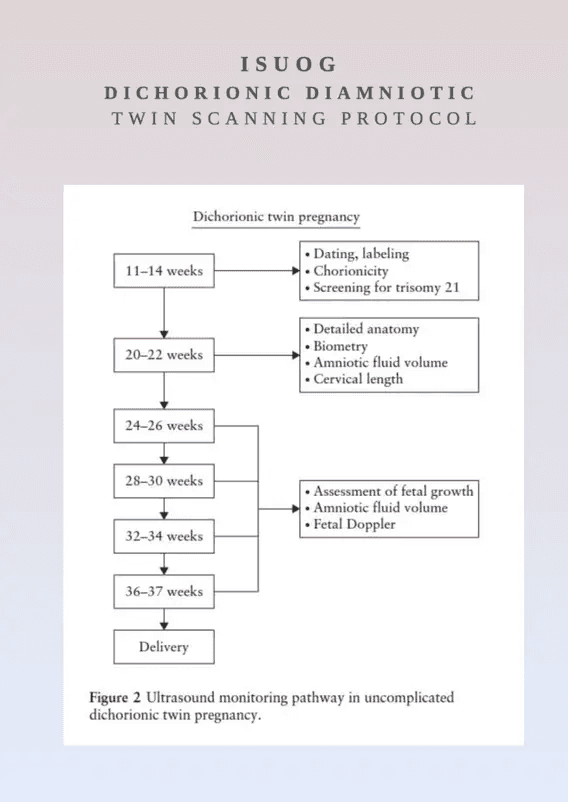
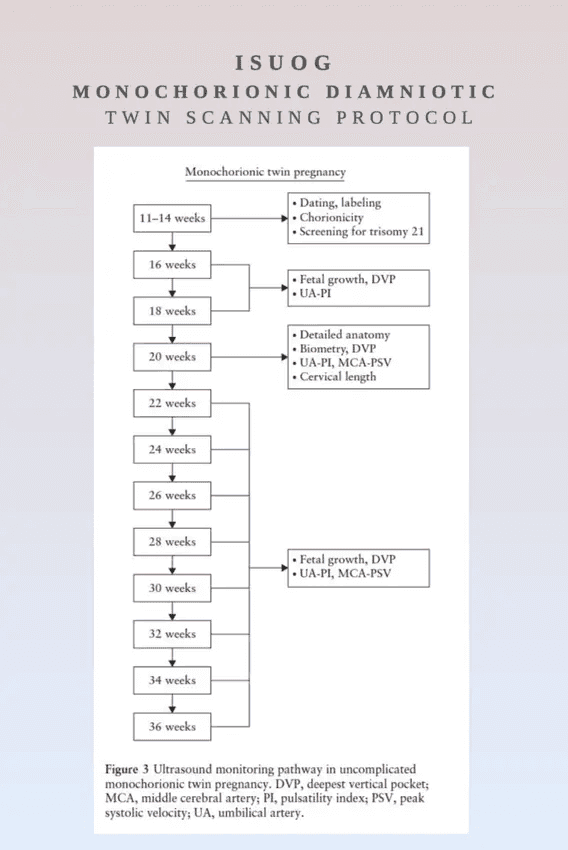
Most countries and generally Australia follows the ISUOG guidelines for twins as per the link here.
At CFWU we follow the ISUOG guidelines for twin scanning, keeping with the highest standards in the world.
As a specialised pregnancy ultrasound service, we are one of the few scanning centres offering growth charts for twin pregnancies to track the growth of both fetuses. This information is critical in decision-making regarding further monitoring and delivery decisions for twin pregnancies.
The Natera Panorama NIPT is the only NIPT test available to find out whether same-gender twins are identical or fraternal.
Establishing chorionicity
One of the first essential information to document on twin pregnancy scans is their chorionicity.
This is assessed by identifying how many placentas and amniotic bags the twins live in.
The placentation is described as dichorionic (two placentas) or monochorionic (sharing one placenta). The number of the inner bags are described as amnitoic bags.
What types of twin pregnancies are there?
The commonest three types of twin pregnancies are:
- Dichorionic diamniotic twins
- Monochorionic diamniotic twins
- Monochorionic monoamniotic twins
Establishing the chorionicity and type of twin pregnancy is essential for planning frequency of ultrasound scans , interpretation of ultrasound findings as well as delivery decision making.
Why is a twin pregnancy more complicated than a singleton pregnancy?
Twin pregnancies are increasing worldwide with the incidence of twin rising from 1:80 to 1:40 pregnancies.
Every pregnancy is an amazing relationship between the mother and the fetus. There are also potential complications that can occur in a pregnancy that are more commonly seen in a twin pregnancy. There are also some risks specific to a twin pregnancy.
The potential risks to the mother from a twin pregnancy include:
- Increased common pregnancy symptoms including nausea, vomiting , hyperemesis, back pain, constipation, leg swelling, tiredness, sleeplessness
- Increased risk of bleeding during the pregnancy
- Increased risk of placenta praevia-low implanted placenta
- Increased risk of preeclampsia and BP issues
- Increased risk of diabetes in pregnancy
The fetus itself has many dangers that should be monitored for and appropriate action taken to have the best possible outcome. These dangers are double for a twin pregnancy and is complicated by the sharing of the space, nutrition and blood supply.
The potential fetal complications to monitor for include:
- Increased miscarriage risk of one or more of the fetuses
- Increased risk of preterm labour
- Fetal growth restriction of one or both of the fetuses
Specific risks associated with monochorionic twin pregnancies such as TTTS, TAPS, Selective fetal growth restriction
Dichorionic diamniotic twin pregnancy (DCDA)
Dichorionic twin pregnancy is characterized by the development of two chorions/placentas, the outermost membrane in a pregnancy. The two fetuses are housed in two separate amniotic sacs. This is the most common type of twin pregnancy and is the safest.
DCDA twin pregnancies can arise from two separate eggs or the early division of a single embryo.
The diagnosis is usually made by first trimester ultrasound showing two separate pregnancy sacs, placentas and amniotic sacs.
The ultrasound Lambda sign is thought to be specific at the side of membrane insertion in a DCDA twin pregnancy
Monochorionic diamniotic twin pregnancy (MCDA)
Monochorionic diamniotic twin pregnancy is a unique and complex type of twin pregnancy that involves the twins sharing the same placenta but live in two separate amniotic sacs. They account for a third of twin pregnancies and carries increased risk to the mother and fetuses.
Women carrying MCDA twin pregnancies should be closely monitored throughout the pregnancy with more frequent ultrasound and antenatal appointments by specialised obstetric and sonographer teams with training in high-risk pregnancy.
The complications specific to monochorionic twin pregnancies are twin twin transfusion syndrome (TTTS). Twins anaemia polycythaemia (TAPS) and selective growth restriction. These complications occur in about 20% of monochorionic pregnancies and are managed by Maternal Fetal medicine specialists. Centre for Women’s Ultrasound doctors are maternal fetal medicine specialist who are experienced in scanning and managing complicated twin pregnancies and are ideally placed to assist with diagnosing and advising on twin pregnancy complications.
Monochorionic monoamniotic twin pregnancy
Monochorionic monoamniotic twin pregnancy is a rare form of identical twin pregnancy with one placenta/chorion and one amniotic sac. In addition to the complications that occur in a MCDA twin pregnancy , this type of a twin pregnancy is considered particularly high risk due to the two fetuses sharing the same space, potentially leading to cord accidents. These pregnancies are monitored very closely with weekly ultrasounds and delivered early around 32-34 weeks to prevent pregnancy loss from cord accidents. With care from maternal fetal medicine specialists, monoamniotic twin pregnancies can have good outcomes and survival of both twins.
Triplet pregnancy
Centre for Women’s Ultrasound has the experience to scan and consult regarding triplet pregnancies.
Triplets pregnancies can have one, two or three placentas and the risks and the management is based on the placentation.
The scanning concepts are similar to the twin pregnancies and specialised Maternal Fetal medicine level expertise is required for the interpretation and advising of management.
Common questions
Can't find your answer here? Our team is happy to help before your appointment.
There are three main types of twin pregnancies based on the number of placentas and amniotic sacs the fetuses share:
- Dichorionic Diamniotic (DCDA) Twins: This is the most common type of twin pregnancy, accounting for about 70% of twin pregnancies. In DCDA twins, each fetus has its own placenta (dichorionic) and amniotic sac (diamniotic). This type of pregnancy is considered the least risky for complications.
- Monochorionic Diamniotic (MCDA) Twins: In MCDA twins, the fetuses share a single placenta (monochorionic) but have their own amniotic sacs (diamniotic). This type of twin pregnancy occurs in about 30% of cases and carries a higher risk of complications compared to DCDA twins, such as twin-twin transfusion syndrome (TTTS) and selective fetal growth restriction (sFGR).
- Monochorionic Monoamniotic (MCMA) Twins: MCMA twins are the rarest type of twin pregnancy, occurring in less than 1% of cases. In this type, the fetuses share both a placenta and a single amniotic sac. MCMA twins are at the highest risk of complications, including cord entanglement and compression, which can lead to fetal demise. These pregnancies require close monitoring and early delivery.
Determining the type of twin pregnancy is important for managing the pregnancy and assessing the risk of complications. It is typically determined through ultrasound examinations early in the pregnancy.